 WarSimBox

A cavalry horse
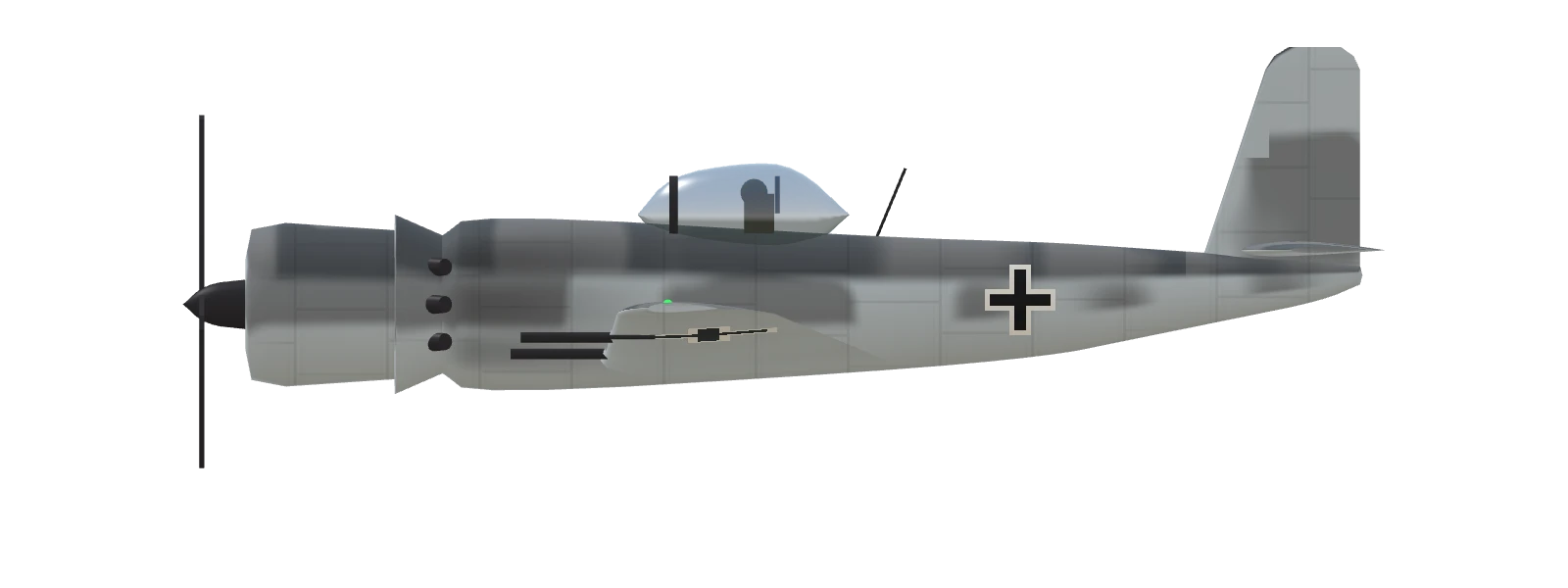
Kurt Tank wanted not a delicate “racehorse” like the Bf 109 but a “cavalry horse”, tough under front-line conditions. The Fw 190’s wide-track undercarriage was attached to the wings and safe on rough airfields. Its radial engine was robust and could keep running after being hit, and the “Kommandogerät”, which set throttle, propeller and mixture from a single lever, eased the pilot’s workload. Its near-bubble canopy gave a good view.
The “Fw 190 crisis”
The Fw 190 A was faster than the Spitfire Mk V, climbed better and rolled much faster. The RAF suffered under this for about a year. In June 1942 a lost German pilot landed at an RAF airfield in Wales, giving the British an intact Fw 190 to study; their answer was the Spitfire Mk IX.
Its weakness: altitude
The BMW 801’s supercharger fell short above 6–7 km, so high up the Fw 190 A was weaker than both the Spitfire IX and the American fighters. It was therefore used at low and medium altitude, in ground support and, with its heavy guns, against bombers. The later long-nosed Fw 190 D largely solved the problem with the liquid-cooled Jumo 213 engine.
In WarSimBox
In the game it is an energy fighter and the fastest-rolling of the piston aircraft. Its four 20 mm cannon give it very heavy firepower, it is rugged and it is effective against bombers. It loses power at high altitude. In a sustained turning fight the Spitfire beats it; it wins with its roll and with dive-and-zoom attacks.
Unlocked in the aircraft tree after researching Messerschmitt Bf 110 C-4 and 2000 hp radial engine. Leads on to: Republic P-47D Thunderbolt, Grumman F6F-5 Hellcat.
- Top speed
- 652 km/h · 5,500 m
- Climb
- 14.9 m/s
- Sustained turn
- 22.6 s
- Stall speed
- 164 km/h
These figures come from the game’s flight model (climb, turn and stall at sea level).
Fly it in WarSimBox